Water-Based vs Plastisol Inks: Which Is More Sustainable?
In This Guide
Explore the key sections, comparisons, and questions covered in this guide.
If you're researching custom clothing, you'll quickly discover that almost every printer has an opinion on ink. Some promote water-based inks as the environmentally responsible choice. Others defend plastisol for its durability, consistency and proven performance. Read enough websites, and you'll soon find yourself asking a simple question:
Which ink is actually more sustainable?
It's a sensible question—but it doesn't have a simple answer.
The biggest mistake people make is assuming sustainability depends on choosing one type of ink over another. In reality, the environmental impact of a printed garment depends on far more than whether the ink is water-based or plastisol. Ink formulation, production methods, garment choice, order size, waste, durability and responsible manufacturing all influence the outcome. That means anyone looking for a simple winner is likely to miss the bigger picture.
That's why this guide takes a different approach. Rather than telling you which ink is "best", we'll examine what the available evidence actually shows. We'll compare water-based and plastisol inks fairly, explain where common assumptions break down and help you understand the trade-offs behind each system. By the end, you'll be in a much stronger position to evaluate environmental claims for yourself instead of relying on marketing language.
🌿 Is Water-Based Ink Really More Sustainable Than Plastisol?
The short answer is simple: it depends on what you mean by sustainable.
Many articles present water-based inks as the obvious environmental winner, while plastisol often appears as an outdated technology with little place in responsible garment printing. Neither view tells the whole story. Water-based inks often support more environmentally responsible printing, particularly when manufacturers back them with recognised certifications, responsible chemical management and transparent documentation. However, water-based doesn't automatically mean environmentally friendly. The formulation, the production process and the wider lifecycle of the printed garment all influence its overall environmental impact.
The same principle applies to plastisol. Traditional plastisol inks attracted criticism because many formulations contained PVC and phthalates. Those concerns encouraged significant changes across the textile printing industry, and many manufacturers now offer phthalate-free plastisol systems while continuing to develop formulations that comply with modern chemical regulations and restricted-substance requirements. Therefore, comparing today's plastisol technology with products from decades ago creates an incomplete and potentially misleading picture.
That doesn't mean the differences between the two technologies have disappeared. Instead, the comparison has become more nuanced. A print-on-demand DTG order using certified water-based inks may reduce waste by producing garments only when customers place an order. Equally, a large screen-printing run using modern plastisol inks may deliver exceptional durability and production efficiency while minimising waste across thousands of identical garments. Both examples can support responsible production—but for different reasons.
Rather than asking which ink is "the greenest", ask which ink system best suits your project and whether credible, independently verifiable evidence supports the environmental claims manufacturers make. That's the question responsible buyers should ask, and it's the question this guide sets out to answer.
🧪 What Are Water-Based and Plastisol Inks?
Although many people present water-based and plastisol inks as direct competitors, the two technologies work in fundamentally different ways. Understanding those differences makes it much easier to compare their environmental characteristics. Before comparing sustainability, it's worth understanding what each ink actually is.
Water-Based Inks
Water-based inks use water as the primary carrier within the ink system. As the ink cures, the water evaporates, and the remaining binders and pigments become part of the printed design. Because the ink penetrates the fibres of the garment rather than sitting heavily on the surface, water-based prints often produce a softer finish, particularly on cotton garments.
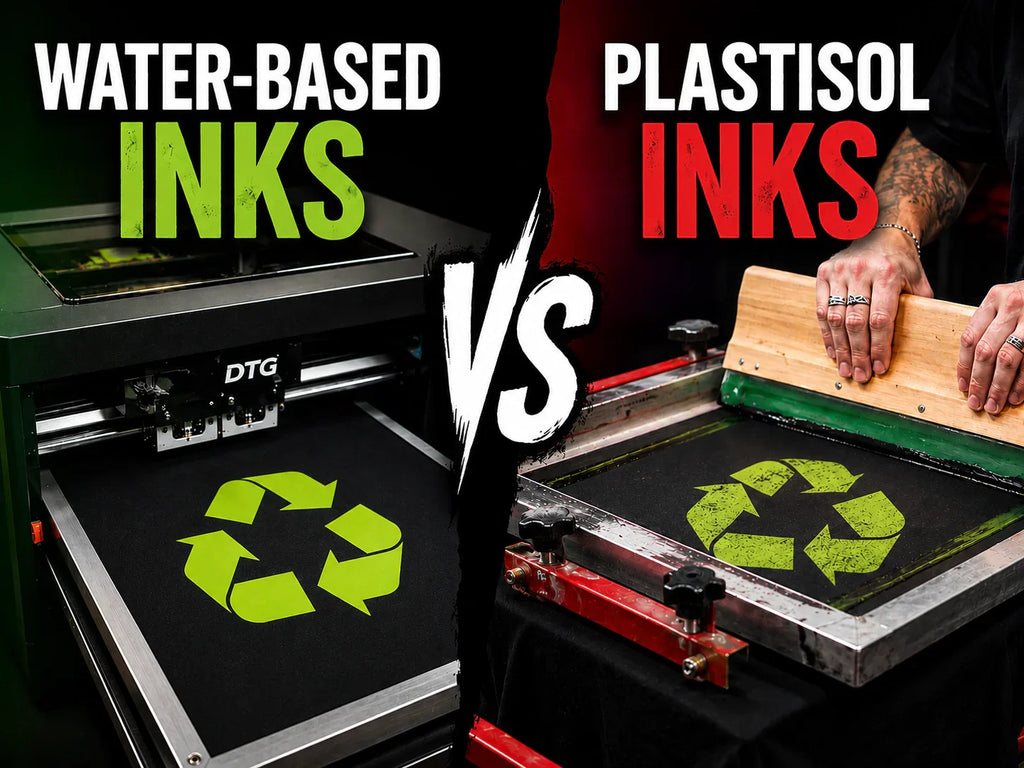
Water-based technology isn't limited to one printing method. Direct-to-garment (DTG) printing relies almost entirely on sophisticated water-based ink systems. At the same time, many screen printers also use water-based inks to create premium retail garments with a soft-hand finish. That distinction matters because many people assume that "water-based" automatically means DTG printing, when in reality it refers to a much broader family of textile inks.
It's equally important not to assume that every water-based ink delivers the same environmental performance. Different manufacturers use different formulations, pigments, binders and supporting chemistries. As with any manufactured product, the environmental profile depends on far more than a single ingredient. Water acts as the carrier, but it doesn't automatically indicate how responsibly the ink has been formulated or manufactured.
That's why independent certifications and manufacturer evidence matter. Looking beyond phrases such as "water-based" or "eco-friendly" helps you understand what manufacturers have actually assessed and which claims they can genuinely support.
Plastisol Inks
While water-based inks rely on water as the carrier, plastisol takes a very different approach. Instead of using water as the primary carrier, plastisol inks consist mainly of PVC particles suspended within liquid plasticisers. Heat cures the ink by causing those particles to fuse into a durable printed layer rather than allowing the print to dry through evaporation.
That curing process gives plastisol several characteristics that have made it the dominant screen-printing ink for decades. It produces vibrant colours, excellent opacity on dark garments and highly durable prints that perform consistently across long production runs. Those qualities explain why plastisol remains widely used throughout the commercial garment-printing industry.
Much of plastisol's environmental reputation comes from older formulations that relied on chemicals now subject to much greater scrutiny and tighter regulation. Modern plastisol systems have evolved considerably, and many manufacturers now offer phthalate-free formulations and, in some cases, PVC-free alternatives for specific applications. Those developments don't remove every environmental concern, but they do mean fair comparisons should reflect today's products rather than assumptions based on outdated technology.
As with water-based inks, it's important to judge plastisol using current evidence rather than historical perceptions. The question isn't whether one technology has a perfect environmental profile. The real question is whether manufacturers support their claims with transparent documentation, responsible chemical management and evidence that reflects today's products.
⚖️ How Do Water-Based and Plastisol Inks Compare?
The comparison also needs to consider the printing system itself. Water-based inks are used across several printing technologies, while plastisol is primarily associated with screen printing. Comparing inks without considering how printers use them risks oversimplifying the environmental picture.
Once you move beyond marketing language, the comparison becomes much more balanced. Neither ink system wins every category because each offers strengths and compromises depending on the application, production method and environmental factor you consider. That's exactly why broad claims such as "water-based is always better" or "plastisol is bad for the environment" rarely stand up to closer scrutiny.
Rather than relying on broad assumptions, the comparison below examines the two systems by focusing on the factors that matter most.
Comparison: Water-Based vs Plastisol Inks
| Factor | Water-Based Inks | Plastisol Inks |
|---|---|---|
| Primary print methods | DTG and screen printing | Primarily screen printing |
| PVC content | Typically PVC-free | Depends on formulation |
| Phthalates | Typically not associated with modern systems | Depends on formulation |
| Soft hand feel | Excellent | Heavier print feel |
| Opacity on dark garments | Depends on the process | Excellent |
| Durability | Excellent when correctly cured | Excellent |
| Production efficiency | Depends on order size | Excellent for long production runs |
| Print-on-demand suitability | Excellent | Generally not suitable |
| Sustainability | Depends on formulation, production method and use case | Depends on formulation, production method and use case |
One point immediately stands out from the comparison: sustainability doesn't belong in a single row. Instead, it emerges from the way the entire printing system works. Ink chemistry, production efficiency, curing, durability, waste reduction and garment lifespan all contribute to the environmental impact of the finished product. Understanding those wider factors is far more valuable than trying to identify a single "greenest" ink.
That's exactly where the evidence takes us next. Rather than comparing individual features in isolation, the next section examines what current research tells us about the environmental strengths, limitations and trade-offs associated with both water-based and plastisol ink systems.
🔎 What the Evidence Really Says
Once you examine the available evidence, the comparison between water-based and plastisol inks becomes much more balanced. That's also where many online discussions begin to oversimplify the subject. Rather than weighing the strengths and limitations of each ink system, they often assume that water-based automatically means sustainable while plastisol automatically means environmentally harmful. Current evidence doesn't support such a straightforward conclusion. Instead, it shows that sustainability depends on several interconnected factors, including chemical formulation, production methods, energy use, durability, waste generation and the way printers manufacture garments. Looking at only one of those factors rarely gives you the full picture.
Why Formulation Matters
The terms "water-based" and "plastisol" describe ink technologies, not complete environmental profiles. Water-based indicates that water is the primary carrier in the ink system, while plastisol refers to a different ink chemistry. Neither term tells you everything you need to know about the finished formulation, the chemicals it contains or the environmental standards it meets.
That's why credible manufacturers publish technical documentation, safety information and independent evidence rather than relying solely on marketing language. Technical data sheets, safety data sheets and recognised certifications allow customers to evaluate specific claims instead of relying on reassuring phrases such as "eco-friendly", "green printing" or "environmentally safe".
Modern water-based inks often support lower-impact positioning because many formulations avoid PVC and align with recognised textile chemical standards. However, manufacturers still formulate those inks using different pigments, binders and additives. Water doesn't determine the environmental profile on its own, and no manufacturer should suggest otherwise.
Modern plastisol formulations have also changed significantly. Many manufacturers now produce phthalate-free plastisol inks, while others offer PVC-free alternatives for specific applications. Those developments don't eliminate all environmental considerations, but they do show why comparisons based on decades-old formulations no longer reflect the products that many printers use today.
The evidence points towards a simple conclusion: evaluate the formulation, not the label.
Why the Production Method Matters
Ink chemistry represents only one part of the sustainability equation. The production method often influences the environmental outcome just as much as it affects waste, energy consumption, production efficiency, and the number of garments printers manufacture unnecessarily.
Direct-to-garment printing provides a good example. Because DTG naturally supports print-on-demand production, businesses can print garments only after customers place an order. That approach reduces the likelihood of manufacturing stock that never sells and helps minimise unnecessary textile waste. For businesses producing personalised garments or smaller orders, that production model can offer significant environmental advantages that extend well beyond the ink itself.
Screen printing solves a different production challenge. Once printers prepare the screens, they can produce large quantities of garments quickly and consistently. For long production runs, that efficiency reduces setup costs per garment while delivering highly consistent print quality across thousands of identical items.
Neither production method automatically produces the lower environmental impact. Printing one personalised T-shirt creates a very different manufacturing process from producing ten thousand garments for a nationwide event. Comparing those two jobs as though they share the same environmental profile oversimplifies the discussion before it even begins.
That's why meaningful comparisons evaluate complete printing systems rather than isolated components. The ink matters, but so do production volume, manufacturing efficiency, garment choice and the practical realities of how printers produce finished clothing.
Durability Is Part of Sustainability
Discussions about sustainable printing often focus on what goes into an ink while overlooking what happens after the garment leaves the printer. Yet durability plays an important role in the overall environmental picture because garments that remain in regular use for longer generally need replacing less often. Extending a garment's useful life can reduce resource consumption regardless of which ink technology produced the original print.
Both water-based and plastisol inks can produce highly durable prints when applied and cured correctly. Plastisol has traditionally built its reputation on exceptional durability, while continuous improvements in water-based chemistry have significantly narrowed that gap. Today's comparison, therefore, looks very different from the one many people still remember from twenty years ago.
Rather than assuming one technology will always last longer than the other, buyers should consider the garment's quality, the manufacturer's recommendations, the printer's production standards, and whether the finished product suits its intended use. Those factors usually tell you far more about long-term performance than the ink category alone.
Energy, Cleaning and Waste
Ink forms only one part of the environmental picture. Printers also consume energy while curing garments, preparing equipment before production begins and carrying out cleaning procedures once production finishes. Those activities all contribute to the finished product's environmental impact, although their significance varies with equipment, workflow, production volume, and operational practices.
For example, curing temperatures, screen preparation, reclaim processes and equipment efficiency all influence the resources required to produce finished garments. Some production methods require more preparation before printing begins, while others reduce setup time but operate differently during production. Those practical differences make universal sustainability claims difficult to justify.
The available evidence doesn't support that conclusion. Instead, it suggests that equipment, workflow, chemical management, production planning and operational efficiency collectively influence environmental performance far more than ink chemistry alone.
What the Evidence Shows
Although no single factor determines sustainability, several consistent themes emerge from the available evidence. Modern water-based inks often support stronger environmental claims because many formulations avoid PVC, align with recognised certification programmes and integrate naturally with print-on-demand production models that help reduce unnecessary waste. At the same time, modern plastisol inks deserve a more balanced assessment than they sometimes receive. Manufacturers have significantly improved many formulations, particularly by removing phthalates and improving compliance with modern chemical regulations. At the same time, plastisol continues to offer outstanding durability and production efficiency for many large-scale screen-printing applications.
That doesn't mean the two technologies have become environmentally identical. It means that informed buyers should avoid broad assumptions and instead examine the complete system. Ink formulation, production method, garment choice, supporting evidence and manufacturing practices all influence the final environmental outcome. Focusing on only one of those elements almost always produces an incomplete answer.
That broader perspective naturally raises another question. If environmental claims depend so heavily on evidence rather than marketing language, how can buyers tell which claims genuinely deserve their confidence?
That's exactly where recognised certifications become valuable.
✅ Questions to Ask Before Choosing a Printing Company
If sustainability matters to your business, clothing brand or organisation, don't stop at asking whether a printer uses water-based or plastisol inks.
Instead, ask questions that help you understand the evidence behind the claims.
Ask questions such as:
- Which printing method do you recommend for my project, and why?
- Which ink system do you use?
- Are your inks water-based, plastisol, hybrid or another system?
- Are your inks PVC-free or phthalate-free?
- Which independent certifications or declarations support your ink system?
- Can you provide links to official certification documents or manufacturer evidence?
- Do the certifications apply to the ink, the finished garment or the wider production process?
- How do you cure your prints and verify wash durability?
- How do you manage ink waste, cleaning and wastewater?
- Do you print garments to order or manufacture stock in advance?
- Which garments do you recommend for customers prioritising sustainability?
The quality of the answers often tells you more than the claims themselves. Printers that explain their processes clearly, provide supporting evidence and acknowledge trade-offs generally deserve greater confidence than those that rely on broad environmental claims.
🤔 Final Thoughts
So, which is more sustainable: water-based ink or plastisol?
The evidence doesn't identify a universal winner. Modern water-based inks often support stronger environmental claims, particularly when manufacturers support them with recognised certifications, transparent documentation and production methods that reduce unnecessary waste. Modern plastisol inks, however, have also evolved considerably. Many formulations now avoid phthalates, while manufacturers continue improving performance without sacrificing the durability and production efficiency that have made plastisol the industry standard for many screen-printing applications.
The better question is not which ink sounds more environmentally friendly. The better question is which printing system supports its environmental claims with credible evidence. Compare the formulation. Compare the production process. Compare the supporting evidence. Then make your decision.
Marketing can help you choose a printer.
Evidence helps you choose the right one.
If you'd like to explore the evidence behind sustainable garment printing in more detail, these related guides build on the topics covered throughout this guide.
❓ Frequently Asked Questions About Water-Based and Plastisol Inks
The guide above compares water-based and plastisol inks in detail. These FAQs answer some of the most common follow-up questions about sustainability, screen printing and DTG printing.
🌿 Are water-based inks always more sustainable than plastisol inks?
No. Water-based inks often support stronger environmental positioning because many formulations avoid PVC and align with recognised certification programmes. However, sustainability also depends on formulation, production methods, durability, waste reduction, garment choice and the evidence supporting the environmental claim. No single factor determines whether one printed garment is more sustainable than another.
🧪 Is plastisol ink bad for the environment?
Not necessarily. Older plastisol formulations raised legitimate environmental concerns because many contained PVC and phthalates. Modern plastisol inks have improved significantly, with many manufacturers now offering phthalate-free formulations and, in some cases, PVC-free alternatives. The specific formulation provides a much better indication than the word "plastisol" alone.
🧾 Do modern plastisol inks still contain phthalates?
Many modern plastisol ink manufacturers now produce phthalate-free formulations. However, specifications vary between manufacturers, so ask your printer which ink system they use and whether they can provide supporting manufacturer documentation.
💧 Are all water-based screen-printing inks PVC-free?
No. Many water-based screen-printing inks are PVC-free, but "water-based" refers to the carrier system rather than to every ingredient in the formulation. Always check the manufacturer's published specifications before assuming a particular environmental characteristic.
👕 Which ink lasts longer: water-based or plastisol?
Both ink systems can produce highly durable prints when printers apply and cure them correctly. Garment quality, print technique, curing standards and garment care all influence print longevity just as much as the ink itself.
🔥 Does water-based ink always use less energy than plastisol?
No. Water-based inks still require drying and curing, while some modern plastisol systems cure at lower temperatures than older formulations. Energy consumption depends on the complete production process rather than the ink category alone.
✋ Which ink feels softer on a T-shirt?
Water-based inks often produce a softer feel because they typically penetrate the fabric rather than sitting as a thicker layer on the surface. Plastisol can feel slightly heavier, particularly on large solid prints. However, the garment fabric, print technique and the amount of ink applied all influence how the finished print feels.
🔎 How can I tell whether a printing company's sustainability claims are genuine?
Ask for evidence rather than relying on marketing language. A credible printing company should explain which ink system it uses, provide manufacturer documentation where appropriate, explain the certifications supporting that ink system and describe how its production methods contribute to responsible manufacturing.
-
Posted in
Sustainable